why n8n workflow automation matters now
n8n workflow automation replaces repetitive manual actions with deterministic, auditable workflows.
These workflows operate across marketing systems, operations tooling, and customer lifecycle platforms.
The platform suits teams that require more than basic one-step integrations.
It supports branching logic, retries, webhooks, structured data transformations, custom code, version control practices, and self-hosted deployment for sensitive data flows.
n8n workflow automation
For corporate gifting and digital marketing operations, the value is concrete:
- fewer missed leads and follow-ups
- faster quote-to-order
- consistent personalization at scale (names, budgets, event themes)
- fewer fulfillment errors (SKUs, addresses, timing)
- tighter attribution (campaign → lead → quote → order → repeat)
n8n workflow automation — what it is and how it works
what is n8n
n8n is a workflow automation platform (fair-code licensed) that connects apps, databases, and APIs using a visual workflow builder plus optional JavaScript for custom logic.
It supports both cloud and self-hosted deployment, and positions itself as flexible for technical teams building business process automation and AI-enabled flows.
the core execution model
Most n8n workflows reduce to four primitives:
- Trigger: webhook, schedule, form submission, CRM event, email inbox, database change.
- Transform: parse, validate, enrich, dedupe, route.
- Act: create/update records, send messages, generate assets, write to storage, call vendor APIs.
- Observe: logging, notifications, error handling, retries, metrics.
where n8n differs from lightweight automation tools
- First-class webhooks for inbound events and integrations.
- Richer control flow (branches, loops, error handlers).
- Self-hosting for data residency and security posture.
n8n workflow automation — why it fits corporate gifting and digital marketing
the operating constraints in gifting + marketing
Corporate gifting blends e-commerce, account-based selling, and fulfillment logistics.
Digital marketing blends high-volume lead capture with attribution and lifecycle messaging.
The intersection creates failure modes:
- leads captured but not qualified fast enough
- quotes delayed due to manual enrichment
- personalization errors (wrong name, wrong company, wrong event)
- shipping errors (address format, cutoff times, inventory)
- missing attribution (which campaign drove which account)
n8n workflow automation addresses these failure points by converting manual “glue work” into rule-driven, standardized workflows.
Instead of relying on ad hoc coordination, processes execute under consistent, enforceable logic.
the key automations to prioritize
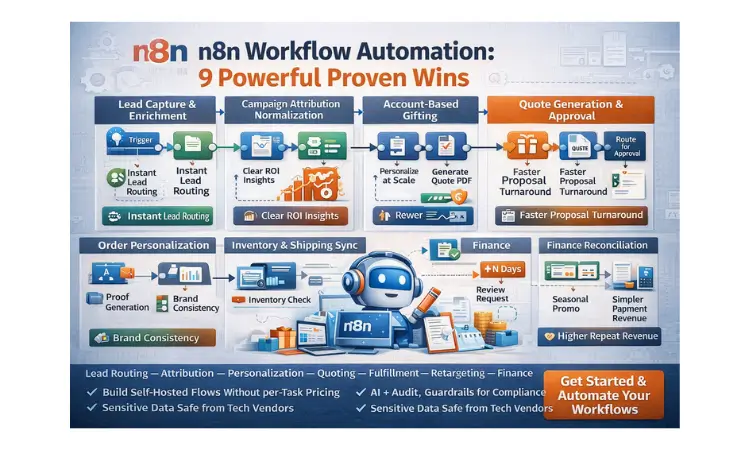
- Lead capture → enrichment → routing
- Inquiry → quote → approval → invoice
- Order → personalization proof → production
- Shipment status → proactive customer updates
- Post-delivery → review request → reactivation
n8n workflow automation — 9 proven workflow patterns that drive results
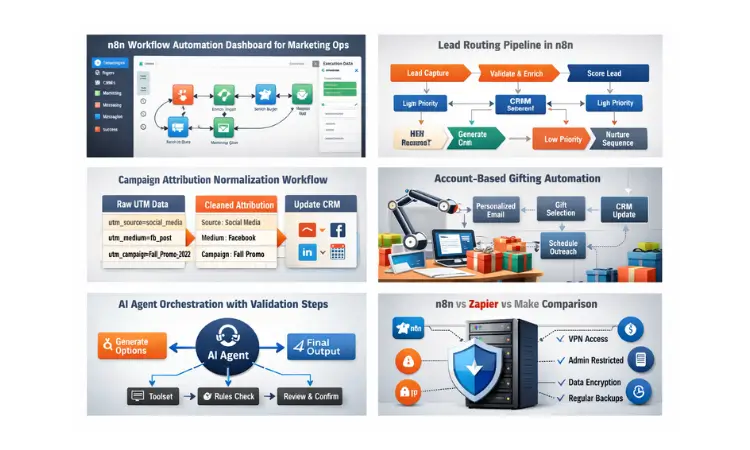
1) lead capture triage (forms, landing pages, inbound email)
Trigger: form submit / webhook
Steps:
- validate fields (work email, company domain)
- enrich via firmographic API
- score using rules (budget, employees, industry)
- route to owner in CRM + Slack/Teams
- create follow-up task sequence
Outcome: faster first response, fewer lost high-intent leads.
2) campaign attribution normalization
Marketing sources arrive messy (UTM variants, inconsistent naming).
Workflow:
- parse UTMs and referrers
- map to canonical campaign IDs
- write standardized fields into CRM + analytics store
- alert when an unmapped campaign appears
Outcome: attribution that survives channel sprawl.
3) account-based gifting outreach at scale
Trigger: target account list update
Workflow:
- enrich contacts (title, location, language)
- generate message variants per persona and region
- schedule sends (email + LinkedIn tasks)
- suppress accounts in active negotiations or recent purchasers
Outcome: personalization without manual spreadsheet gymnastics.
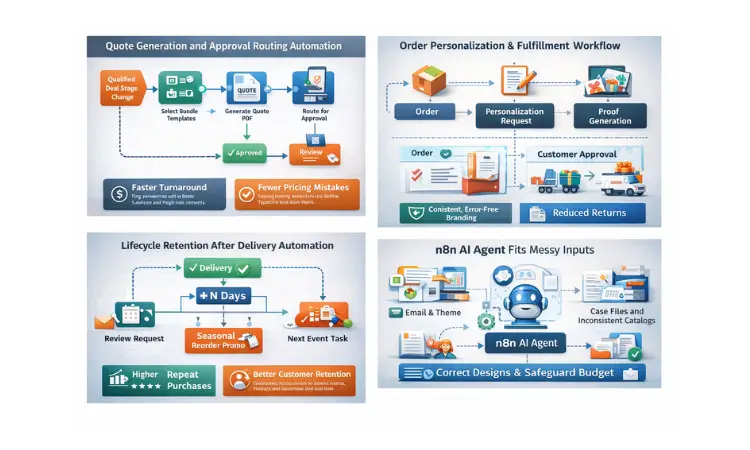
4) quote generation and approval routing
Trigger: qualified deal stage change
Workflow:
- pull product bundle templates based on budget tier
- compute shipping constraints (region, timeline, cutoff)
- generate quote PDF and store in CRM/file storage
- route approval based on discount thresholds
Outcome: fewer stalled deals, fewer pricing mistakes.
5) personalization pipeline (names, notes, inserts, branding)
Trigger: order paid / PO received
Workflow:
- validate personalization inputs (character limits, forbidden strings)
- generate proofs (mock images, insert text)
- request approval from customer when required
- lock approved assets and attach to fulfillment ticket
Outcome: reduced rework and returns.
6) inventory and vendor synchronization
Trigger: SKU change / nightly job
Workflow:
- pull stock from vendors
- compute available-to-promise with buffers
- update storefront + internal catalog
- flag SKUs with inconsistent lead times
Outcome: fewer backorders and canceled orders.
7) shipping status monitoring and proactive comms
Trigger: carrier webhook / periodic polling
Workflow:
- map carrier events to customer-friendly statuses
- notify customer at key milestones
- escalate exceptions (failed delivery, weather delay) to ops
Outcome: fewer support tickets, higher trust.
8) invoice reconciliation and finance handoff
Trigger: invoice created / payment received
Workflow:
- match payments to invoices
- reconcile fees and discounts
- update accounting system
- generate exception report for finance
Outcome: faster close, fewer manual reconciliations.
9) lifecycle retention after delivery
Trigger: delivery confirmed + elapsed days
Workflow:
- request feedback/review
- trigger reorder nudges for seasonal moments
- create “next event” tasks for account owners
- suppress if negative feedback exists
Outcome: higher repeat revenue from the same accounts.
n8n AI — building agentic workflows without losing control
n8n includes native support for AI agents and modular components inspired by LangChain-style architectures.
Supported agent patterns include conversational flows, plan-and-execute models, ReAct-style reasoning loops, and tool-invoking agents.
where “n8n ai agent” fits in a marketing + gifting stack
Agentic flows make sense when inputs are unstructured:
- inbound emails asking for “ideas under ₹X for a fintech offsite”
- spreadsheet-like lists pasted in chat
- vendor catalogs in inconsistent formats
- subjective constraints (“premium, not flashy, sustainable”)
A practical design:
- deterministic pipeline for compliance and correctness
- agent step for interpretation and drafting
- deterministic validation step again before execution
OpenAI integration inside n8n
n8n provides an OpenAI node with supported operations for common OpenAI tasks and can be used inside broader workflows and agent toolchains.
n8n vs alternatives — selecting the right automation layer
Dimension | n8n | Zapier | Make |
Control / extensibility | High (code + advanced flow) | Medium | Medium-High |
Self-hosting | Yes | No | No |
Cost model | Depends on deployment/plan; can avoid per-task scaling | Often task-based scaling | Ops-based scaling |
Best fit | Technical teams, complex workflows, data control | Quick no-code integrations | Visual logic-heavy automations |
Reference comparisons and positioning: n8n’s own comparison material and third-party overviews.
n8n workflow automation — implementation blueprint for production
architecture and environments
- separate dev/stage/prod workflows
- credential isolation per environment
- secrets management and encryption keys
- backup/restore plan for workflows and runtime state
Self-hosting requires baseline ops competence (servers/containers/security/config).
workflow engineering standards
- naming conventions (trigger_action_object)
- input contracts (schemas for webhooks/forms)
- idempotency keys for order/lead creation
- retries with backoff for flaky APIs
dead-letter handling for failures
observability and audit
- central log sink
- per-workflow run dashboards
- error notifications that include run IDs and payload hashes
- change management for workflow edits
n8n news — security posture and operational risk
Recent reports identified critical vulnerabilities in specific n8n versions.
In some configurations, untrusted users with workflow creation or editing access exposed systems to remote code execution risk.
Internet-facing deployments increased the exposure surface.
These findings reinforce the need for disciplined patch management, strict access control, and systematic hardening.
minimum viable hardening checklist
- keep to patched stable versions and track release notes cadence
- restrict workflow creation/editing to trusted admins
- block public exposure of admin surfaces; isolate via VPN/allowlists
- rotate credentials and use least-privilege API tokens
- separate public webhook ingress from the core runtime when possible
FAQ Section
1) n8n workflow automation supports complex marketing + ops routing beyond simple triggers
2) what is n8n in practice: a visual automation layer with optional JavaScript and self-hosting
3) n8n ai workflows work best when paired with deterministic validation and approval gates
4) n8n news and release notes should drive patch cadence and operational controls
5) n8n vs Zapier selection hinges on control, self-hosting needs, and scaling economics
6) n8n ai agent patterns map to unstructured requests, while deterministic nodes enforce correctness
n8n Workflow Automation for Corporate Gifting and Digital Marketing
A practical guide to building production-grade lead routing, attribution cleanup, and account-based outreach.
Covers quote approval pipelines, personalization proofs, inventory sync, shipping alerts, invoice reconciliation, and post-delivery retention.
Includes AI agents with deterministic guardrails, security hardening, self-hosting strategy, observability, and error handling standards.
Designed for teams running complex workflows across CRMs, email, Slack, warehouses, carriers, vendors, and analytics platforms.
n8n: the practical automation layer for teams that need control
Modern teams run on dozens of SaaS tools, internal databases, spreadsheets, and ad-hoc scripts.
The friction is not a lack of software; it is the glue work between systems: copying fields, reconciling IDs, chasing approvals, and rebuilding the same integrations every quarter.
This is where n8n workflow automation.
becomes an engineering asset instead of a convenience tool.
What n8n is in operational terms
n8n is a visual workflow engine that orchestrates triggers, transformations, and actions across APIs.
It supports webhooks, schedules, conditional branching, looping, retries, and custom JavaScript.
That combination matters because most business processes are not linear.
They branch on lead quality, region, inventory availability, payment status, compliance constraints, and human approvals.
With n8n workflow automation.
you can model those branches explicitly, keep execution traceable, and reduce “tribal knowledge” dependencies.
Why teams adopt n8n instead of lightweight zaps
Lightweight automation tools work for simple one-to-one syncing.
n8n becomes the better fit when you need one or more of these:
- Multi-step flows with strong sequencing and rollback discipline
- Data shaping (normalize, dedupe, enrich, validate) before writes
- Deterministic handling of failures (retries, dead-letter, alerts)
- Webhook ingress and event-driven processing
- Self-hosted deployment for governance, residency, or cost control
These needs are common in growth and revenue operations, especially where errors are expensive.
n8n workflow automation.
is less about “connecting apps” and more about “encoding operating procedures.”
The core building blocks that make it production-capable
A production workflow typically contains:
- Triggers: webhooks from forms, CRM events, payment providers, carrier status updates, database polling, or schedules.
- Transformations: parsing, schema validation, unit conversions, enrichment calls, score calculation, routing rules, and idempotency keys.
- Actions: create/update CRM records, send messages, generate documents, call vendor APIs, write to warehouses, open tickets, and post alerts.
- Controls: timeouts, retries with backoff, error branches, rate limiting, and circuit-breaker logic for flaky dependencies.
The difference between a demo and production is discipline around data contracts and error handling.
With n8n workflow automation.
every node becomes a controlled interface, not an implicit assumption.
Pattern 1: lead capture to qualification to routing
High-performing funnels do not depend on someone “checking the inbox.” A robust workflow:
- Capture a lead via webhook from landing pages, chat widgets, or forms
- Validate required fields and reject obvious spam patterns
- Enrich company and contact data (firmographics, domain matching)
- Score and route to owners using territory and capacity rules
- Create tasks and sequence enrollment with suppression logic
This pattern eliminates slow response and inconsistent follow-up.
n8n workflow automation.
turns inbound into a deterministic pipeline.
Pattern 2: quote creation with approvals and pricing guardrails
Quoting is where revenue leaks: incorrect bundles, invalid discounts, shipping constraints ignored, approvals missed.
A controlled workflow:
- Select a bundle template by segment and budget tier
- Compute shipping constraints and cutoff dates by region
- Generate quote documents and attach them to the CRM
- Route approvals based on discount thresholds and margin rules
- Notify stakeholders and create a traceable audit trail
This is not “automation for speed” only; it is automation for correctness.
n8n workflow automation.
can enforce guardrails that humans forget under pressure.
Pattern 3: personalization proofs and fulfillment handoff
In gifting and branded campaigns, personalization introduces high variance.
A workflow can:
- Validate personalization inputs (length limits, restricted strings, locale rules)
- Generate proofs (mockups, inserts, packaging notes)
- Request approval when needed and lock approved assets
- Create fulfillment tickets with immutable references to proofs
- Escalate exceptions when assets are missing or ambiguous
The outcome is fewer reprints, fewer returns, and fewer support escalations.
n8n workflow automation.
makes the “last mile” less fragile.
Pattern 4: inventory and vendor synchronization
If you sell physical products, stale inventory is an operational tax.
A nightly or event-driven workflow can:
- Pull stock and lead times from vendors and warehouses
- Compute available-to-promise using buffers and reserved quantities
- Update storefront, internal catalog, and sales quoting rules
- Flag SKUs with inconsistencies or abnormal drift
- Emit exception reports to ops channels
Instead of reacting to backorders, you prevent them.
n8n workflow automation.
is a control system for operational reality.
Data quality as a first-class requirement
Most workflow failures are data failures: nulls, schema drift, duplicate keys, inconsistent country codes, invalid phone formats, and mismatched IDs.
Treat each integration boundary as a contract:
- Validate input schema before transformation
- Canonicalize enums (country, state, currency, campaign naming)
- Deduplicate using stable identifiers and fuzzy matching when needed
- Implement idempotency to prevent double writes
- Store payload hashes and run IDs for postmortems
If you do this, incident response becomes analysis, not guesswork.
n8n workflow automation.
works best when paired with explicit contracts.
Where AI fits, and where it does not
AI is useful when the input is unstructured: inbound emails, “free-text” requirements, messy vendor catalogs, or subjective gift constraints.
The safe pattern is:
- AI for interpretation and drafting (extract constraints, propose bundles, summarize messages)
- Deterministic validation against business rules (budgets, restricted items, lead time)
- Human approval gates for high-impact actions
- Deterministic execution and logging
This avoids the trap of letting a probabilistic system execute irreversible operations.
n8n workflow automation.
should keep AI inside guardrails, not as the guardrail.
Observability: make failures legible
Production workflows fail.
The goal is fast detection, clear diagnosis, and bounded blast radius. Implement:
- Structured logs with correlation IDs
- Error branches that capture payload, node, and reason
- Alerting policies based on severity and volume
- Dead-letter queues for reprocessing after fixes
- SLO-like monitoring for critical flows (lead routing, payment posting, shipping updates)
Without this, automation becomes silent debt.
With it, automation becomes operational leverage.
n8n workflow automation.
should be treated like a service, not a toy.
Security and self-hosting considerations
Self-hosting is valuable for governance and control, but it raises responsibility:
- Restrict who can create or edit workflows
- Isolate admin surfaces from the public internet
- Use least-privilege credentials per integration
- Rotate secrets and avoid hardcoding tokens in nodes
- Patch promptly and track release notes
- Back up workflows and configuration, and test restores
Security is not a single setting; it is continuous operations.
n8n workflow automation.
is safest when deployment is treated as an engineered system.
A deployment checklist that prevents common failures
- Define environments (dev/stage/prod) and separate credentials
- Standardize naming conventions and node-level documentation
- Establish reusable sub-workflows for shared steps (enrichment, dedupe, notifications)
- Version workflows and change-manage updates
- Load test webhook endpoints and rate limits
- Create a runbook for incidents and reprocessing
This is the difference between “automating” and “operationalizing.”
n8n workflow automation.
becomes durable when you build it like infrastructure.
n8n is not only a connector tool; it is a workflow runtime for encoding business logic, ensuring traceability, and hardening operations.
When you treat workflows as products—versioned, observable, and governed—you replace manual fragility with repeatable systems.
Done well,
n8n workflow automation.
becomes a competitive advantage through speed, correctness, and control.
Conclusion
n8n workflow automation provides a production-grade automation layer for corporate gifting and digital marketing:
lead routing, attribution, quoting, personalization, fulfillment, finance reconciliation, and retention workflows.
AI agents fit the unstructured edges, while deterministic guardrails preserve correctness.
Track release notes, keep instances patched, and harden access for internet-facing deployments.
n8n workflow automation, n8n, workflow automation, marketing automation, corporate gifting, n8n ai, n8n ai agent, n8n vs zapier, self-hosted automation, lead routing
n8n replaced manual handoffs with tracked workflows—faster lead routing, quicker quotes, fewer personalization errors, proactive shipping updates, and cleaner reconciliation.
Johnson Lucas Tweet
A comprehensive guide to n8n workflow automation for marketing operations and corporate gifting, covering lead routing, attribution tracking, quote generation, personalized outreach, order fulfilment,
AI governance controls, and security implementation.


Add comment